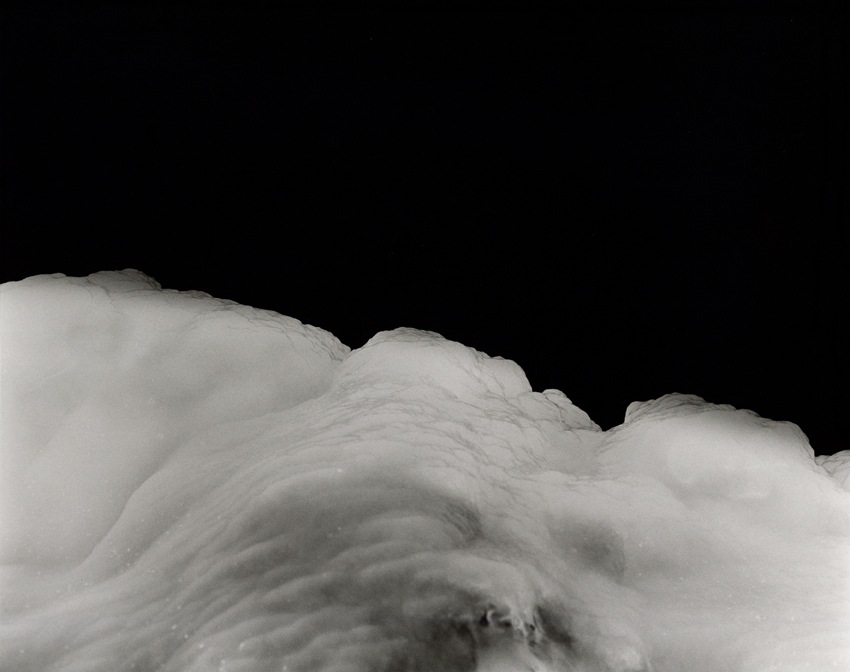
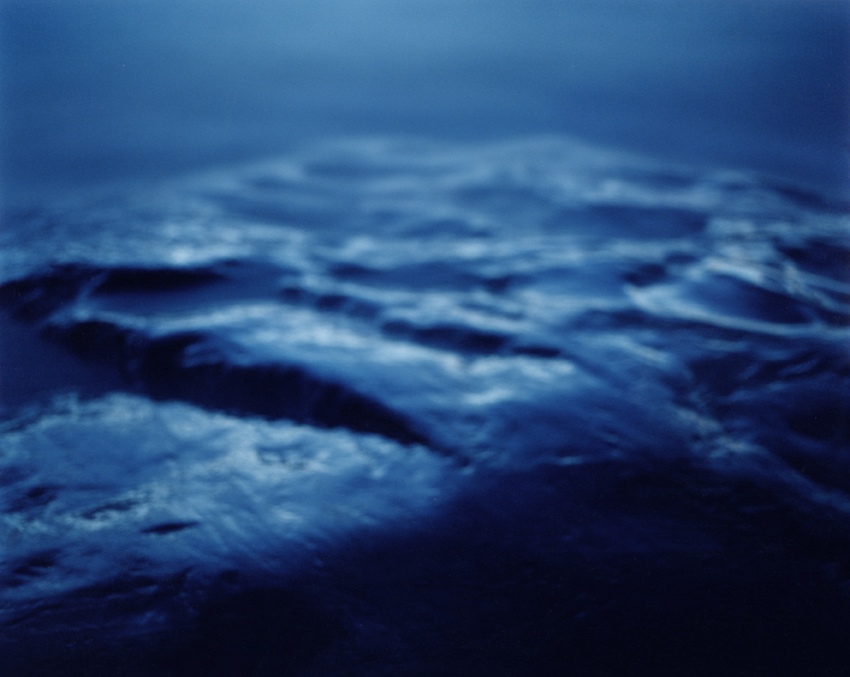
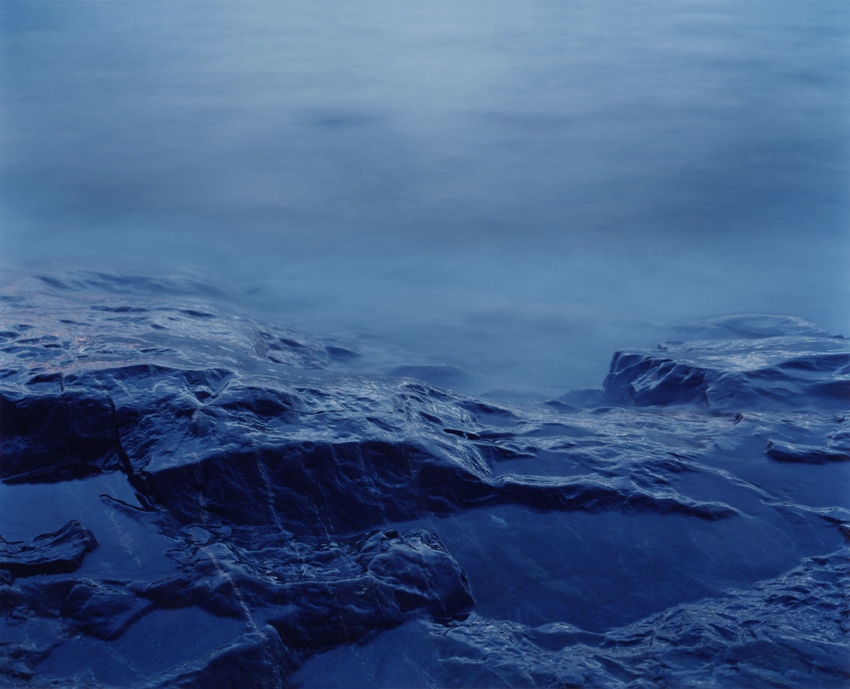
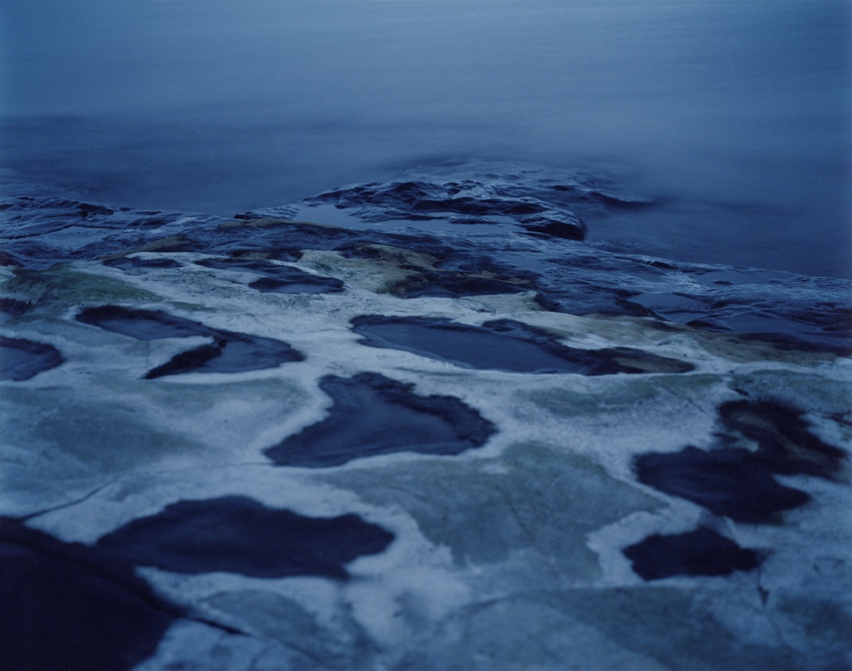
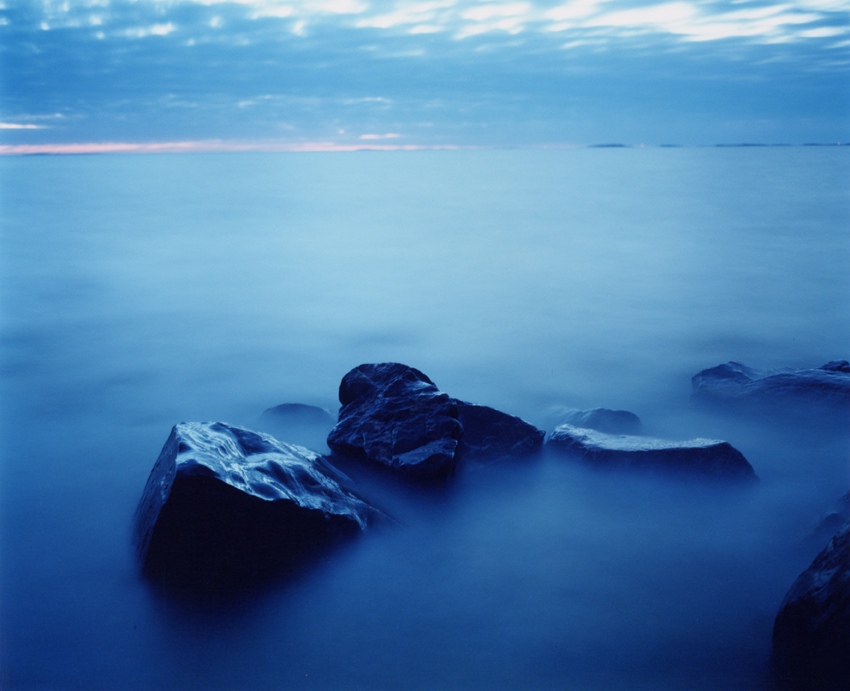
In the dark hours of twilight, the human eye often sees more than the camera is able to capture. The film’s limited ability to separate contrasts simplifies the subject, and a long exposure time shifts its colours. The resulting images are almost two-dimensional — some colour fields even turn monochromatic.
These seashore landscapes are mysterious and magical, and deeply personal to me. The land in South Western Finland rises about 40 centimetres every hundred years — a difference that can be seen in one’s lifetime. The slow changes in the landscape of the Archipelago fascinate me, and I keep wondering how different it looked through the eyes of our ancestors.
I keep returning to the same places to take my photographs. I have photographed seasons, different times of day, early mornings, blue nights, fog, the movements of water, ice, snow, light and shadows. I have wanted to shoot landscapes without any trace of human presence.
At sunrise and sunset nature seems magical and mystical. As light fades, the shutter speed gets longer and the passing of time becomes more concrete. In these conditions the limitations of the camera as an observational tool become visible. In twilight our other senses grow more dominant — hearing and smell become sharper. Looking at my pictures afterwards, I remember the smells: juniper, seaweed, the saltiness of the air. Sounds arrive before the sun, as birds and insects wake up first. You cannot see these sensations in the pictures, but their presence is in them.
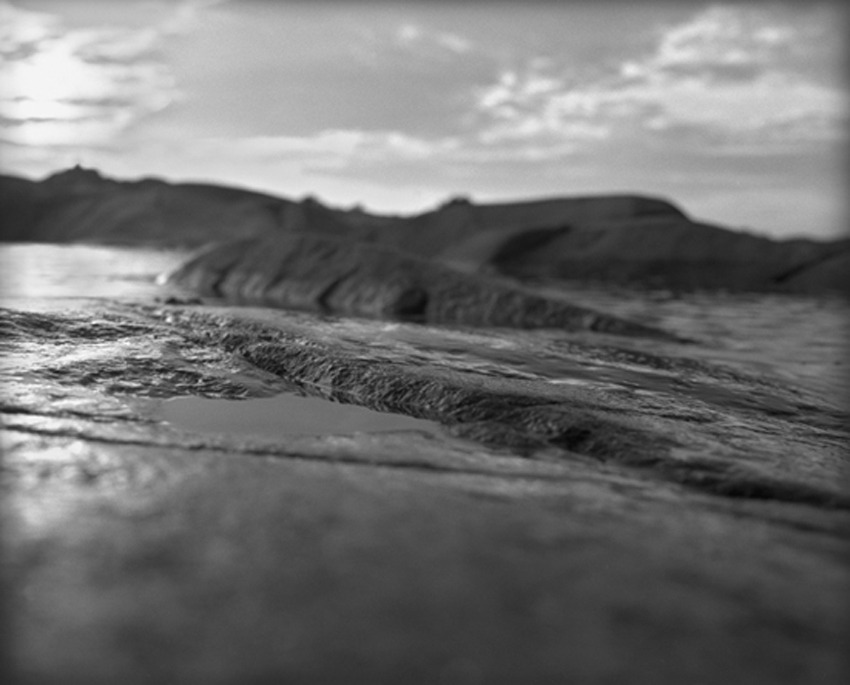
I get close to my subjects, sometimes with a macro lens, exploring details so carefully that sometimes only colourful dots remain. In some pictures the distance between the lens and the subject is less than 10 centimetres — it is intriguing to find the shapes of the landscape in much smaller dimensions. Scale has become one of the central themes of my work.
On a freezing cold day you can watch water congeal into ice, and in the ice you can see — even touch — the movements of water. The smooth coastal rocks carry imprints of those movements too. The points of compass, winds and sea currents give the landscape a certain rhythm and chaotic order. Even the smallest movements of water form different rhythms. The work feels both photographic and metaphysical — the organic energy of a place, captured, yet its secrets stay protected. The meditative mood is a reminder of the irrevocable progress of time, leaving its marks on solid rocks as well as on our aging skin. The landscape never stays still.